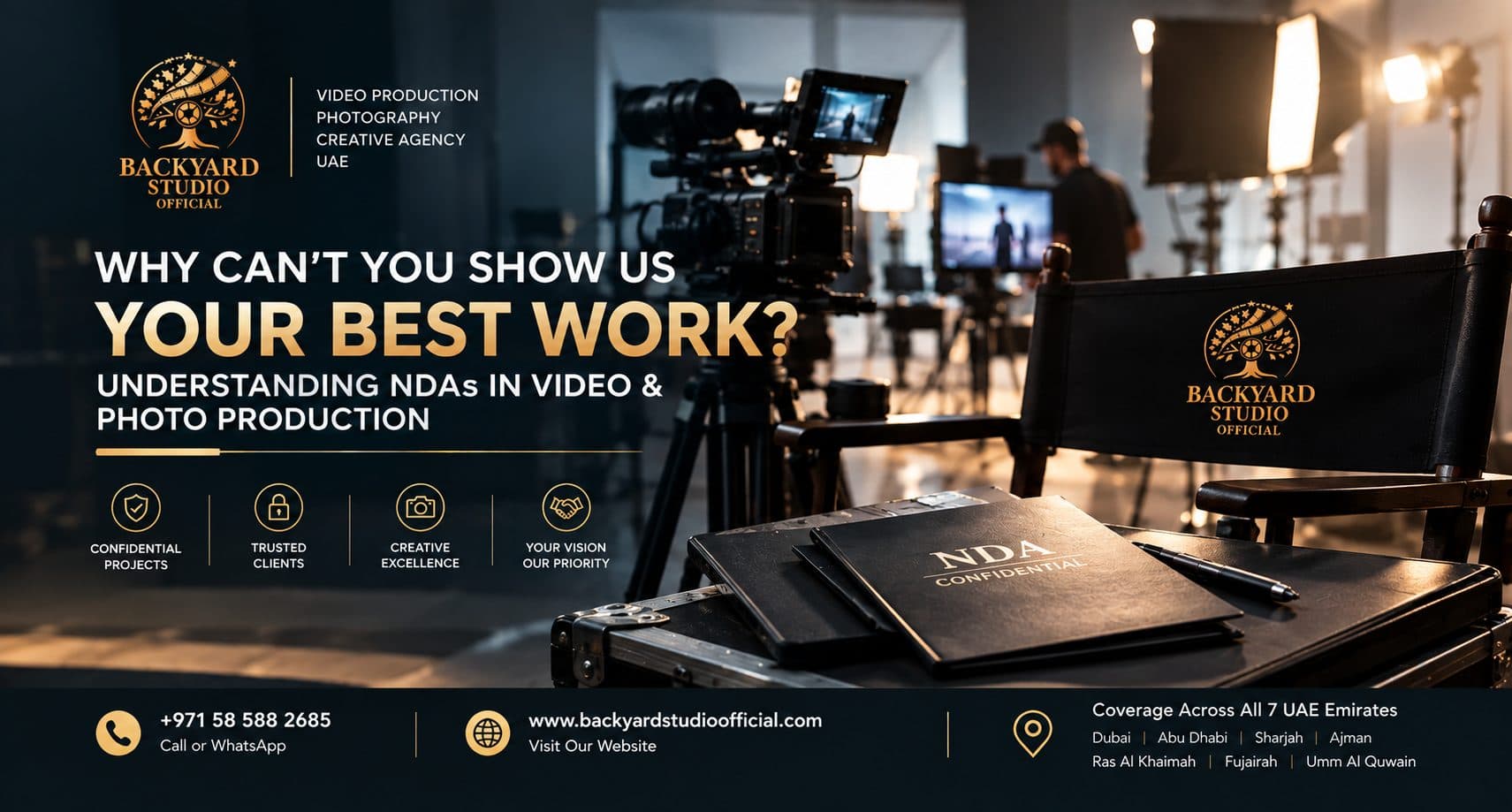
Why Can't You Show Us Your Best Work? Understanding NDAs in Video & Photo Production
Can we see some reference shots from similar shoots, or the client names?" Sometimes the honest answer is that we can't — and that's not us hiding a lack of experience. It's usually a sign of exactly the opposite.
# Why Can't You Show Us Your Best Work? Understanding NDAs in Video & Photo Production
The Question We Get on Almost Every Call
"Can you send over some reference shots from a similar shoot? And who else have you worked with — any names we'd recognise?"
It's a completely reasonable thing to ask. Anyone hiring a production studio wants proof, not just a promise. But the honest answer, on a genuine share of projects, is: **we can't show you that specific work, and we can't tell you that client's name.** Not because it doesn't exist. Often because it's some of the best, highest-budget, most technically demanding work a studio has ever produced — and it's sitting behind a signed non-disclosure agreement that legally prevents it from being shown, named, or even acknowledged.
This is genuinely confusing for a lot of clients the first time they hit it, so it's worth explaining properly, once, in plain language.
What an NDA Actually Restricts (It's Not All-or-Nothing)
Confidentiality agreements in the production and creative industry generally fall into a few different tiers, and understanding the difference explains why the restriction varies so much project to project:
- **Full lockdown.** The studio cannot mention the client's name, cannot confirm the project happened, and cannot show any footage or imagery, ever, without written permission. This is common with government work, product launches ahead of a public announcement, and high-profile brand or celebrity projects. - **Named but not shown.** The studio can say "we've worked with [Client]" but cannot show the actual deliverables, internal footage, or specific creative details. - **Embargoed.** Everything can eventually be shown, but only after the client's own product, campaign, or event has launched publicly — which might be months after the shoot itself.
This is why a studio might say "we can't show you that" about one project and happily hand over full case studies for another. It isn't inconsistency. It's respecting the exact terms each individual client agreed to.
Why This Should Actually Increase Your Confidence, Not Lower It
Here's the part that's counterintuitive but worth sitting with: **the projects a studio can't show you are very often the ones that prove the most.** A brand doesn't put a strict NDA on a small, low-stakes shoot. NDAs show up on the work that matters most to a client — major campaigns, unreleased products, confidential internal projects, high-profile individuals, government and diplomatic work. A studio's NDA list is frequently a rough map of its most serious, highest-trust client relationships, even though the map itself can't be shown to you directly.
A studio that can show you literally everything it has ever produced is, in a strange way, telling you something too — that it hasn't yet been trusted with anything sensitive enough to require protecting.
What a Legitimate Studio Can Still Offer You
An NDA restricts specific outputs. It doesn't erase everything a studio can demonstrate about its capability. This is where the industry concept of a **"shadow portfolio"** comes in — a way of proving real, high-level experience without breaching a single confidentiality clause:
- **Anonymised or sanitised samples.** Footage or images with identifying branding, logos, and locations removed or blurred, shown purely to demonstrate technical and creative quality. - **Process and approach, not deliverables.** A studio can generally describe how a project was planned, shot, and produced — the thinking, the problem-solving, the scale — without showing or naming the actual output. - **Category-based reference work.** Instead of "here's the exact video we made for Client X," a studio can show a comparable, non-restricted project in the same category — same type of shoot, same level of production value, different (nameable) client. - **Testimonials without attribution.** Written or verbal feedback from a confidential client, shared with their permission but without their name attached. - **A verified reference call.** For serious, later-stage enquiries, some studios can arrange a call where a confidential client verbally confirms the relationship and quality of work to a prospective client directly, without anything being put in writing or shown publicly. - **A "select clients" list without case studies.** Simply naming who a studio has worked with, where permitted, even without showing the specific project.
What to Ask Instead of "Can I See It?"
If a studio tells you a specific project is under NDA, these questions get you real signal without asking anyone to breach a contract:
1. "Can you describe the scale and complexity of that project, without naming the client or showing the output?" 2. "Do you have a comparable project in the same category you can show me instead?" 3. "Is there a sanitised or anonymised version of this available?" 4. "Would the client be open to a brief verbal reference call, even without written material?" 5. "What can you tell me about your process on that project?"
A studio with genuine experience will have real, specific, confident answers to all five. A studio that's overstating its experience generally can't.
A Reasonable Middle Ground for Both Sides
The healthiest version of this conversation isn't the client demanding proof a studio legally can't provide, or the studio hiding behind "trust us" with nothing to back it up. It's a studio that's upfront the moment an NDA applies, explains clearly what tier of restriction is in place, and immediately offers the closest legitimate alternative — a sanitised sample, a comparable project, or a verified reference — rather than leaving the client with silence and a vague excuse.
If a studio genuinely can't offer any of that for a project it claims to have done, that's worth being more sceptical about than the NDA itself.
---
Our Own Position on This
Backyard Studio Official has produced work for clients across the UAE and internationally under exactly these kinds of agreements — government-adjacent projects, product launches ahead of public announcement, and brand campaigns where naming the client before their own release date simply isn't ours to do. When that applies, we'll tell you plainly, and we'll offer what we legitimately can: comparable work, a sanitised sample, or a description of the project's scale and complexity. What we won't do is pretend the restriction doesn't exist, or quietly show you something we agreed not to.
**Call or WhatsApp:** +971 58 588 2685 **Website:** www.backyardstudioofficial.com **Coverage:** Dubai, Abu Dhabi, Sharjah, Ajman, Ras Al Khaimah, Fujairah, Umm Al Quwain
READY TO SHOOT?
Let's Work Together
Get a custom production quote delivered within 2 hours.