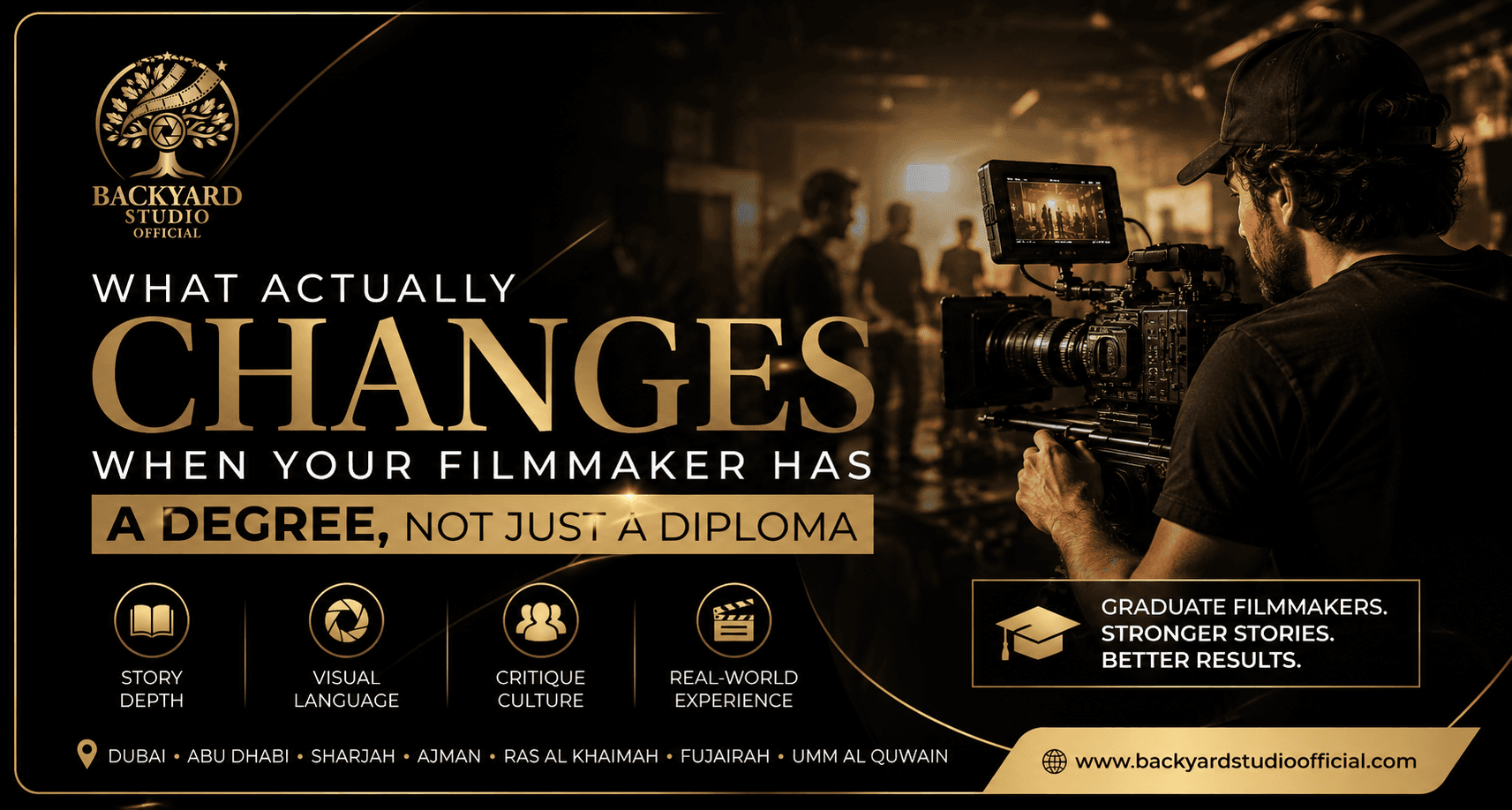
What Actually Changes When Your Filmmaker Has a Degree, Not Just a Diploma
A diploma teaches you which buttons to press. A film degree teaches you why the shot works. Here's the honest difference, and what it actually means for the video you end up with.
# What Actually Changes When Your Filmmaker Has a Degree, Not Just a Diploma
Quick Answer
Backyard Studio is built by graduate filmmakers - trained through full film degree programmes, not short diploma courses - producing video content across Dubai, Abu Dhabi, Sharjah, Ajman, Ras Al Khaimah, Fujairah, and Umm Al Quwain. To be fair, a diploma or self-taught path can absolutely produce skilled, talented filmmakers - qualifications alone don't guarantee good work. What a full degree programme does reliably add is deeper training in story structure, visual language, and critical feedback culture, which tends to show up in how confidently a project is planned and shaped, not just how it's filmed.
---
Let's Be Honest About What a Qualification Actually Proves
It would be easy to write this as "degree good, diploma bad" - but that's not true, and it's not a fair thing to say. Some of the most talented filmmakers working today never finished a formal course of any kind. Passion, practice, and a genuine eye for a shot matter more than a piece of paper. So this isn't about claiming one qualification makes someone a better filmmaker than another. It's about being honest about what each type of training actually covers, so you know what to ask about when you're choosing who films your project.
---
What a Diploma Typically Covers
A diploma course is usually shorter and more technical by design - and that's not a flaw, it's the format. It tends to focus on:
- How to operate a camera and basic lighting setup - Fundamentals of editing software - Practical, on-the-job style skills to get someone shooting quickly
This produces people who can competently run a shoot and deliver a video. For many projects, that's genuinely enough.
---
What a Full Film Degree Typically Adds
A degree programme is usually built over several years, and covers a wider foundation before it ever gets to "which button does what":
- **Story structure and narrative theory** - understanding why a story works, not just how to point a camera at it - **Visual language and film history** - studying how decades of filmmakers have used framing, movement, and colour to create meaning, not just aesthetics - **Critique culture** - years of having work reviewed and challenged by tutors and peers, which builds the habit of questioning your own first idea instead of settling for it - **Cross-discipline exposure** - most degree programmes require students to try directing, editing, cinematography, and sound at some point, giving graduates a genuine understanding of every role on set, not just their own - **A larger volume of practice projects** - several years of coursework typically means dozens of full projects completed and critiqued before ever working professionally
---
Where This Actually Shows Up in the Final Video
The difference isn't usually visible in "can they operate the camera" - most trained people can. It tends to show up earlier and later in the process:
- **At the planning stage** - a stronger instinct for why a shot serves the story, not just whether it looks nice - **On set** - a broader understanding of what the editor and colourist will need later, because the filmmaker has stood in those roles themselves - **In the edit** - a habit of questioning the first cut rather than accepting it, built from years of formal critique - **In problem-solving** - when something doesn't work on the day, a wider creative toolkit to solve it rather than reshooting the same idea
---
What This Means for Your Project, Practically
This isn't a reason to distrust every diploma-trained filmmaker - plenty do excellent work. It is a reasonable thing to ask about directly when comparing options, the same way you'd ask about a portfolio or process:
1. Ask what training or background the person filming and editing your project actually has 2. Ask to see a project they directed or story-shaped themselves, not just filmed 3. Ask how they approach the planning stage - do they talk about story and purpose, or only equipment and schedule? 4. Judge the portfolio itself above all - training explains tendencies, but the actual work is still the proof
---
Video Production Pricing in the UAE (2026)
| Package | Price Range (AED) | What's Included | |---|---|---| | Social media reel/short-form | 2,500 - 6,000 | Half-day shoot, 1 camera, 1-3 edited clips | | Corporate video/DVC | 8,000 - 25,000 | Scripting, multi-camera crew, full post-production | | Wedding videography | 5,000 - 30,000+ | Highlight reels to full cinematic films | | Event videography | 6,000 - 20,000 | Multi-camera coverage, fast-turnaround edit | | Multi-day brand campaign | 25,000 - 60,000+ | Full team, multiple locations/days |
Backyard Studio provides a written, itemised proposal for every project, regardless of scope, so pricing and deliverables are confirmed in advance.
---
How the Backyard Studio Team Approaches a Project
1. **Discovery call** - understand the actual goal behind the video, not just the format requested 2. **Story-first planning** - shot lists and locations are built around narrative purpose, not just visual preference 3. **Filming day** - a crew that understands how each role connects to the next, from camera to eventual edit 4. **Editing with critique built in** - the first cut is questioned and refined, not simply delivered as final 5. **Final delivery** - a video shaped by trained judgement at every stage, not just technical execution
---
Working With Graduate Filmmakers Across the UAE
Backyard Studio's graduate filmmaking team works across Dubai, Abu Dhabi, Sharjah, Ajman, Ras Al Khaimah, Fujairah, and Umm Al Quwain, bringing the same story-first, critique-trained approach to every project regardless of location or scale.
---
Why This Matters When Choosing Backyard Studio
- **Formal film degree training** - years of study in story structure, visual language, and cross-discipline filmmaking, not a short technical course - **A team that has stood in every role** - directing, editing, cinematography, and sound, giving genuine understanding of how each part of a project connects - **Built-in critique habit** - the first idea is questioned and refined, not simply accepted and delivered - **Judged on the work itself** - a portfolio that reflects this training in practice, available to review before you book
---
Frequently Asked Questions
### Does a film degree actually make someone a better filmmaker than a diploma holder?
Not automatically - talent, experience, and practice matter more than any single qualification, and many diploma-trained or self-taught filmmakers produce excellent work. A full degree programme does typically add deeper training in story structure, visual language, and critique culture, which tends to influence how confidently a project is planned and shaped.
### What should I actually look for when comparing filmmakers, degree or not?
The strongest signal is the portfolio itself - ask to see work the person directed or shaped creatively, not just filmed, and ask how they approach the planning stage before assuming training level alone tells you everything.
### What does Backyard Studio's team background actually include?
Backyard Studio is built by graduate filmmakers trained through full film degree programmes, with cross-discipline experience across directing, cinematography, editing, and sound design.
### Does more formal training mean a higher price?
Not necessarily on its own - Backyard Studio's pricing is based on project scope, crew size, and complexity, confirmed through a written itemised proposal, rather than training background alone.
### Can a diploma-trained filmmaker still do excellent work?
Yes, absolutely - qualifications are one factor among many, and skill, experience, and a strong portfolio matter more than the specific type of training completed.
### How does story-first planning actually change the final video?
Planning shots around narrative purpose, rather than visual preference alone, tends to result in a video that holds together as a coherent story rather than a series of nice-looking but disconnected shots.
### Can I see examples of Backyard Studio's directed work, not just filmed projects?
Yes, the Backyard Studio portfolio includes projects the team has directed and creatively shaped from concept through to final edit, available to review during the consultation stage.
---
See the Difference in the Work Itself
Backyard Studio's graduate filmmaking team brings formal training in story, structure, and craft to every project across the UAE. Call or WhatsApp +971 58 588 2685 to see the portfolio and discuss your project.
**Call or WhatsApp:** +971 58 588 2685 **Website:** www.backyardstudioofficial.com **Coverage:** Dubai, Abu Dhabi, Sharjah, Ajman, Ras Al Khaimah, Fujairah, Umm Al Quwain
FREQUENTLY ASKED QUESTIONS
Does a film degree actually make someone a better filmmaker than a diploma holder?
Not automatically - talent, experience, and practice matter more than any single qualification, and many diploma-trained or self-taught filmmakers produce excellent work. A full degree programme does typically add deeper training in story structure, visual language, and critique culture, which tends to influence how confidently a project is planned and shaped.
What should I actually look for when comparing filmmakers, degree or not?
The strongest signal is the portfolio itself - ask to see work the person directed or shaped creatively, not just filmed, and ask how they approach the planning stage before assuming training level alone tells you everything.
What does Backyard Studio's team background actually include?
Backyard Studio is built by graduate filmmakers trained through full film degree programmes, with cross-discipline experience across directing, cinematography, editing, and sound design.
Does more formal training mean a higher price?
Not necessarily on its own - Backyard Studio's pricing is based on project scope, crew size, and complexity, confirmed through a written itemised proposal, rather than training background alone.
Can a diploma-trained filmmaker still do excellent work?
Yes, absolutely - qualifications are one factor among many, and skill, experience, and a strong portfolio matter more than the specific type of training completed.
How does story-first planning actually change the final video?
Planning shots around narrative purpose, rather than visual preference alone, tends to result in a video that holds together as a coherent story rather than a series of nice-looking but disconnected shots.
Can I see examples of Backyard Studio's directed work, not just filmed projects?
Yes, the Backyard Studio portfolio includes projects the team has directed and creatively shaped from concept through to final edit, available to review during the consultation stage.
READY TO SHOOT?
Let's Work Together
Get a custom production quote delivered within 2 hours.