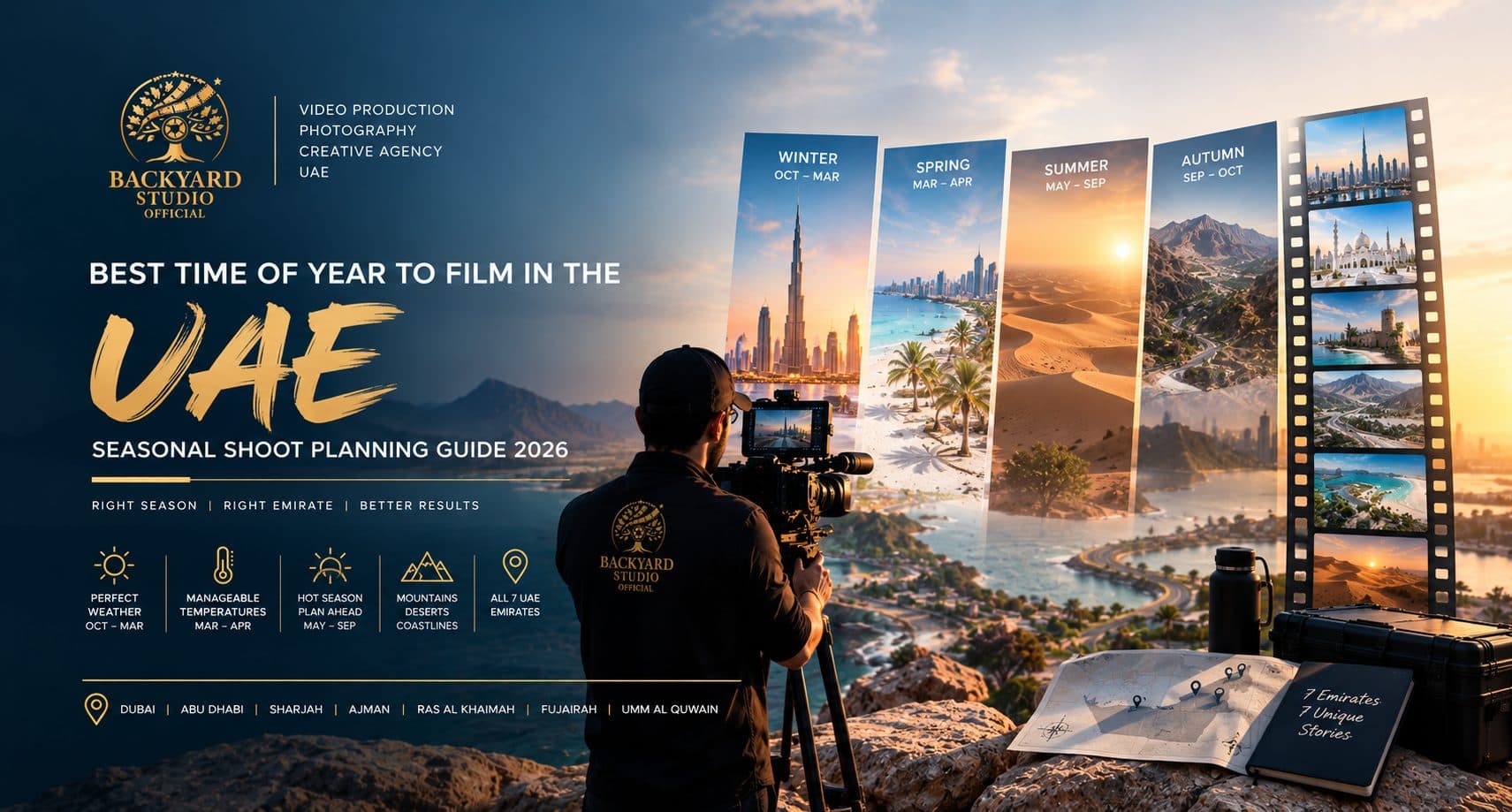
Best Time of Year to Film in the UAE — Seasonal Shoot Planning Guide 2026
October to March is the UAE's prime filming window, but that doesn't mean summer shoots are impossible. Here's how to plan production around heat, humidity, daylight hours and sandstorm risk across all seven emirates.
# Best Time of Year to Film in the UAE — Seasonal Shoot Planning Guide 2026
Quick Answer
The best time to film outdoors in the UAE is October through March, when temperatures are milder and conditions are most workable for crew, talent, and equipment. Summer runs from late April to early October, with July and August the most demanding months — temperatures regularly exceed 43°C with humidity approaching 90%, which makes midday outdoor filming genuinely difficult rather than just uncomfortable. That said, summer shoots absolutely still happen, and Backyard Studio Official schedules them around early morning and late afternoon windows across all seven UAE emirates — Dubai, Abu Dhabi, Sharjah, Ajman, Ras Al Khaimah, Fujairah, and Umm Al Quwain — with indoor and studio alternatives available when conditions make outdoor filming impractical.
---
The UAE Filming Calendar, Month by Month
**October to March — Prime Season.** This is the window most productions aim for. Milder temperatures, lower humidity, and manageable outdoor conditions make full-day exterior shoots practical without compromising crew welfare or equipment reliability. November through February is the strongest stretch within that window, which is also why it's the busiest period for production bookings across the UAE — worth factoring into scheduling well in advance.
**March to April — Transition.** Temperatures climb and humidity rises, but evenings stay pleasant and sea conditions are good. The main consideration here is wind: north-westerly winds and occasional sandstorms are more common in transitional months, which matters for both visibility and equipment protection.
**May to June — Increasingly Demanding.** May regularly exceeds 35°C and June pushes toward 40°C. Outdoor filming remains possible but requires genuine planning around crew welfare, shade, hydration, and shorter shooting windows. Evenings offer meaningful relief.
**July to August — Peak Heat.** The hardest months, with temperatures above 43°C and humidity near 90%. Cameras and batteries struggle, talent suffers, and midday exterior work becomes impractical. Productions scheduled in this window typically pivot toward interiors, studios, or tightly compressed early-morning and evening shoots.
**September to early October — Easing.** Conditions begin improving through September, with early October marking the practical start of the comfortable season again.
Daylight Hours and Golden Hour Planning
The UAE has roughly 10 hours 37 minutes of daylight in December and up to 13 hours 44 minutes in June, so summer actually offers more usable daylight overall — the constraint isn't light availability, it's the temperature during the middle of that light. In the hot season, sunrise is around 05:30 and sunset around 19:00, which means the workable exterior windows are early morning before 9am and late afternoon after 3–4pm. Harsh overhead sun in the middle of the day casts deep, unflattering shadows regardless of season, so diffusion, reflectors, and shade are standard requirements on any UAE exterior shoot, not just summer ones.
Practical Production Considerations by Season
- **Equipment reliability in heat.** Cameras and batteries genuinely underperform in extreme heat. Summer shoots need shaded equipment staging, backup batteries, and realistic expectations about how long gear can run in direct sun. - **Sandstorm and dust risk.** Sudden sand or dust storms can arise, particularly in transitional months, reducing visibility and threatening sensitive equipment. Rain covers, lens shields, and backup gear are worth having on hand even when the forecast looks clear. - **Coastal humidity.** Along the coast, humidity compounds heat, straining both crew and equipment more than inland temperatures alone would suggest. - **Wind near dunes and coastline.** Wind blows sand that can damage equipment and create haze in shots, which affects both desert and coastal locations. - **Ramadan scheduling.** During Ramadan, many services operate reduced hours, which affects crew scheduling, catering, location access, and general production logistics regardless of weather.
How This Differs Across the Seven Emirates
**Dubai and Abu Dhabi:** The core October–March window applies, with extensive indoor and studio alternatives available year-round for productions that can't wait for cooler months.
**Sharjah, Ajman, and Umm Al Quwain:** Similar coastal climate patterns to Dubai, with the same prime October–March window and comparable summer humidity along the coastline.
**Ras Al Khaimah:** Elevation at Jebel Jais means noticeably cooler conditions than the coastal emirates, which can extend the practical outdoor filming window for mountain locations specifically.
**Fujairah:** On the east coast, summer months from June to September bring high temperatures and humidity, with winter from October to March the recommended window for outdoor shoots — consistent with the rest of the country.
Why Season Planning Matters More Than People Expect
The most common scheduling mistake is booking a UAE exterior shoot for July or August because earlier planning stages ran late, rather than because summer was the right creative choice. That decision cascades: shorter usable shooting windows, more crew breaks, equipment reliability risk, and talent comfort issues that show up on camera. Building a shoot date into the production timeline early — ideally targeting the October–March window for anything exterior-heavy — avoids that entirely. When summer filming is genuinely unavoidable, planning around it deliberately from the start produces far better results than treating it as an afterthought.
Frequently Asked Questions
### What is the best month to film in Dubai?
November through February offers the most comfortable filming conditions in Dubai, with milder temperatures and lower humidity making full-day exterior shoots practical. The broader October to March window is generally considered the UAE's prime filming season.
### Can you film outdoors in the UAE during summer?
Yes, but with significant planning. Outdoor filming in July and August is constrained to early morning (before 9am) and late afternoon (after 3–4pm) windows, with midday exterior work largely impractical due to temperatures above 43°C and humidity near 90%.
### How hot does it actually get during UAE summer?
Peak summer temperatures regularly exceed 43°C in July and August, with humidity approaching 90% along the coast. The hot season broadly runs from late April to early October.
### Does the UAE get more daylight in summer?
Yes. The UAE has around 10 hours 37 minutes of daylight in December compared to up to 13 hours 44 minutes in June. The limitation in summer is temperature during those hours, not the amount of available light.
### Are sandstorms a risk for filming in the UAE?
Sandstorms and dust storms can occur, particularly during transitional months, and they reduce visibility while posing a genuine risk to sensitive camera equipment. Rain covers and lens protection are worth carrying regardless of forecast.
### How does Ramadan affect filming schedules in the UAE?
During Ramadan, many services operate on reduced hours, which affects crew scheduling, catering, location access, and general logistics. Productions planning around Ramadan need to account for this in addition to weather considerations.
### Is filming weather different in Ras Al Khaimah or Fujairah?
Ras Al Khaimah's Jebel Jais elevation offers noticeably cooler conditions than the coastal emirates, which can extend the practical outdoor window for mountain locations. Fujairah follows a similar pattern to the rest of the country, with October to March recommended for outdoor shoots.
### Should I book a studio instead of an outdoor location in summer?
For many summer productions, yes — pivoting to an indoor or studio location avoids the heat, equipment, and crew welfare constraints entirely, and often produces a more controlled result than a compressed, heat-limited exterior shoot.
---
Plan Your UAE Shoot Around the Right Season
Backyard Studio Official plans and produces shoots year-round across all seven UAE emirates, scheduling around seasonal conditions and offering indoor and studio alternatives when the weather makes exteriors impractical. Call or WhatsApp the team to discuss your timeline.
**Call or WhatsApp:** +971 58 588 2685 **Website:** www.backyardstudioofficial.com **Coverage:** Dubai, Abu Dhabi, Sharjah, Ajman, Ras Al Khaimah, Fujairah, Umm Al Quwain
FREQUENTLY ASKED QUESTIONS
What is the best month to film in Dubai?
November through February offers the most comfortable filming conditions in Dubai, with milder temperatures and lower humidity making full-day exterior shoots practical. The broader October to March window is generally considered the UAE's prime filming season.
Can you film outdoors in the UAE during summer?
Yes, but with significant planning. Outdoor filming in July and August is constrained to early morning (before 9am) and late afternoon (after 3–4pm) windows, with midday exterior work largely impractical due to temperatures above 43°C and humidity near 90%.
How hot does it actually get during UAE summer?
Peak summer temperatures regularly exceed 43°C in July and August, with humidity approaching 90% along the coast. The hot season broadly runs from late April to early October.
Does the UAE get more daylight in summer?
Yes. The UAE has around 10 hours 37 minutes of daylight in December compared to up to 13 hours 44 minutes in June. The limitation in summer is temperature during those hours, not the amount of available light.
Are sandstorms a risk for filming in the UAE?
Sandstorms and dust storms can occur, particularly during transitional months, and they reduce visibility while posing a genuine risk to sensitive camera equipment. Rain covers and lens protection are worth carrying regardless of forecast.
How does Ramadan affect filming schedules in the UAE?
During Ramadan, many services operate on reduced hours, which affects crew scheduling, catering, location access, and general logistics. Productions planning around Ramadan need to account for this in addition to weather considerations.
Is filming weather different in Ras Al Khaimah or Fujairah?
Ras Al Khaimah's Jebel Jais elevation offers noticeably cooler conditions than the coastal emirates, which can extend the practical outdoor window for mountain locations. Fujairah follows a similar pattern to the rest of the country, with October to March recommended for outdoor shoots.
Should I book a studio instead of an outdoor location in summer?
For many summer productions, yes — pivoting to an indoor or studio location avoids the heat, equipment, and crew welfare constraints entirely, and often produces a more controlled result than a compressed, heat-limited exterior shoot.
READY TO SHOOT?
Let's Work Together
Get a custom production quote delivered within 2 hours.